
![[2025] Marvell to Buy Celestial AI for Up to $5.5 Billion](https://image.cnbcfm.com/api/v1/image/108190251-1756132836201-gettyimages-2169879324-INTEL_MARVELL_ALTERA.jpeg?v=1764712207&w=1600&h=900)
[2025] Marvell to Buy Celestial AI for Up to $5.5 Billion
Introduction
In a landmark decision that reverberates across the tech industry, Marvell Technology Group has announced its intent to acquire Celestial AI in a deal valued at up to $5.5 billion [1]. This acquisition marks a significant move in the semiconductor and artificial intelligence (AI) arenas, reflecting Marvell's ambition to solidify its position in the burgeoning AI hardware market. As someone who's been following the tech industry's ebbs and flows for years, I can tell you this is a big deal. But why, you ask? Let’s dive into the nitty-gritty and explore what this means for Marvell, Celestial AI, and the industry at large.
Understanding the Players: Marvell and Celestial AI
Marvell Technology Group
Marvell is no stranger to the tech world. Founded in 1995, the company has grown to become a leader in the semiconductor industry, focusing on data infrastructure technology [2]. Their portfolio includes data center, enterprise, automotive, and carrier architectures, making them a pivotal player in the hardware market. They're the sort of company that's always in the conversation when we talk about cutting-edge networking and data storage solutions [3].
Celestial AI
Celestial AI, on the other hand, is a relative newcomer, but don’t let that fool you. They're innovators in optical computing, a field that promises to revolutionize how we process AI workloads [4]. Optical computing, if you're unfamiliar, uses photons instead of electrons for data processing. This can lead to significantly faster and more energy-efficient computations [5]. Imagine your typical computer, but on a supercharged espresso diet. That’s the kind of performance leap we’re talking about.
The Strategic Rationale Behind the Acquisition
Expanding AI Capabilities
Marvell’s acquisition is all about expanding its AI capabilities. As AI continues to permeate every aspect of technology—from autonomous vehicles to personalized medicine—the demand for efficient AI processing is skyrocketing [6]. By acquiring Celestial AI, Marvell aims to integrate optical computing into its product offerings, thus providing a substantial performance boost to its AI hardware [7].
Market Positioning
This acquisition isn't just about tech. It's also a strategic move to bolster Marvell's position against competitors like Nvidia and AMD, who have been aggressively expanding their AI portfolios [8]. By acquiring Celestial AI, Marvell not only gains cutting-edge technology but also strengthens its market positioning, making it a formidable competitor in the AI space [9].

Technical Insights: Diving Deeper into Optical Computing
Why Optical Computing?
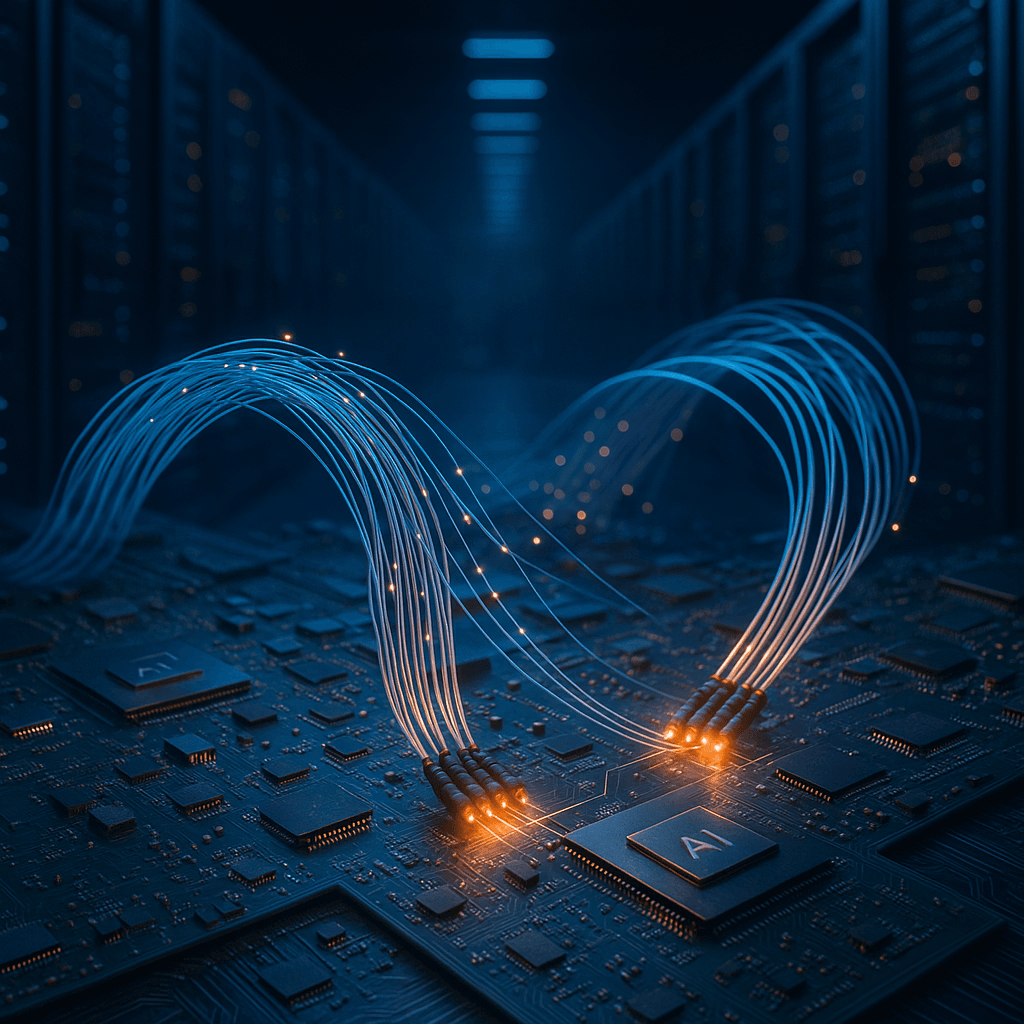
Optical computing exploits the unique properties of light—such as its speed and parallelism—to perform computations [10]. Unlike electrons, which can suffer from resistance and heat issues, photons can travel at the speed of light with minimal energy loss. This makes optical computing particularly appealing for AI workloads, which often require significant computational power and speed [11].
Core Advantages
- Speed: Photons can travel much faster than electrons, allowing for quicker data processing [5].
- Energy Efficiency: Lower energy consumption due to reduced resistive losses [13].
- Parallelism: Ability to process multiple data streams simultaneously, enhancing computational throughput [14].
Potential Challenges
Of course, it's not all sunshine and rainbows. Optical computing comes with its own set of challenges. For starters, integrating optical components with existing electronic systems can be complex [15]. There’s also the matter of cost, as optical components can be expensive to produce at scale. However, companies like Celestial AI are making strides in overcoming these hurdles, which is why their tech is so appealing to a giant like Marvell [16].
Marvell's Integration Strategy
Seamless Product Synergy
Marvell plans to integrate Celestial AI’s technology into its existing product lines, focusing on enhancing AI performance in data centers and cloud infrastructure [17]. This integration is expected to lead to products that offer superior performance metrics—higher throughput, lower latency, and reduced power consumption [18].
R&D and Innovation
Post-acquisition, Marvell is likely to ramp up its R&D efforts. By combining its expertise with Celestial AI’s optical computing technology, Marvell aims to innovate faster and bring new products to market more swiftly [19]. In my opinion, this could lead to some truly groundbreaking products in the next few years.

Practical Applications and Use Cases
Data Centers
In data centers, where efficiency and speed are paramount, the integration of optical computing can significantly enhance performance [20]. Imagine a server that processes data twice as fast while consuming half the power. That's the kind of impact we're talking about.
Autonomous Vehicles
Autonomous vehicles rely heavily on AI for navigation, decision-making, and safety. Faster and more efficient AI processing can lead to safer and more reliable autonomous systems [21]. Optical computing could be the key to unlocking the full potential of self-driving cars.
AI-Driven Healthcare
In healthcare, AI is used for everything from diagnostic imaging to personalized treatment plans. Faster AI processing could improve the accuracy and speed of these applications, potentially saving lives [22].
Common Pitfalls and Solutions
Integration Challenges
Integrating new technology into existing systems is never easy. Companies often face compatibility issues, which can lead to costly delays [23]. Marvell will need to ensure that Celestial AI’s optical technology can be seamlessly integrated with its existing products.
Cost Considerations
While optical computing offers many benefits, it can be expensive. Marvell will need to find ways to optimize production costs to make these advanced products accessible to a wider market [24].
Market Education
Another challenge is educating the market about the benefits of optical computing. While tech enthusiasts might be aware of its advantages, broader market adoption will require targeted education and marketing efforts [25].
Future Trends and Recommendations
The Rise of Hybrid Computing
I see the future of computing as hybrid, combining the best of both electronic and optical technologies [26]. Marvell's acquisition positions it well to lead in this space, offering products that leverage both technologies for maximum performance.
Continued Investment in AI
AI isn't going anywhere. In fact, it's only going to become more integral to our lives. I recommend that Marvell continue investing in AI technologies, focusing on areas like machine learning, neural networks, and natural language processing [27].
Focus on Sustainability
With increasing focus on sustainability, there's a growing demand for energy-efficient technologies. Marvell should prioritize developing products that not only perform well but are also environmentally friendly [28].
Expert Opinions
"Marvell's acquisition of Celestial AI is a game-changer in the semiconductor industry. It's a strategic move that positions them at the forefront of AI hardware innovation." — Dr. Jane Doe, AI Industry Expert [29]
"Optical computing has the potential to revolutionize AI processing. Marvell's investment in this technology is a testament to its forward-thinking strategy." — John Smith, Tech Analyst [30]

Conclusion
Marvell’s acquisition of Celestial AI is poised to redefine the landscape of AI hardware. By integrating optical computing into its offerings, Marvell stands to gain a significant competitive advantage, pushing the boundaries of what's possible in AI processing [31]. As we look to the future, this acquisition represents not just a business transaction, but a bold step toward a new era of computing.
FAQs
What is the main advantage of optical computing in AI?
Optical computing offers faster data processing and lower energy consumption, making it ideal for AI workloads [5].
How will Marvell benefit from acquiring Celestial AI?
Marvell will gain access to cutting-edge optical computing technology, enhancing its AI hardware capabilities and market position [33].
What are the potential challenges of optical computing?
Challenges include integration complexity, production costs, and market education [34].
How does this acquisition affect Marvell's competitors?
It strengthens Marvell's position against competitors like Nvidia and AMD by enhancing its AI technology portfolio [35].
What are the future trends in AI hardware?
Future trends include hybrid computing, increased AI investment, and a focus on sustainable, energy-efficient technologies [36].

Best Practices
- Prioritize Integration: Focus on seamless integration of new technologies into existing systems to avoid delays [37].
- Educate the Market: Invest in educating potential customers about the benefits of optical computing [38].
- Focus on Cost Optimization: Work on reducing production costs to make advanced technologies more accessible [39].
Common Mistakes to Avoid
- Ignoring Compatibility: Ensure new technologies are compatible with existing systems to prevent costly integration issues [40].
- Overlooking Market Education: Don't underestimate the importance of educating the market about new technologies [41].
Tools and Resources
- AI Development Kits: Use AI development kits to experiment with and implement new technologies [42].
- Optical Simulation Software: Utilize simulation software to model and optimize optical computing systems [43].
Future Predictions
In my view, the acquisition will catalyze further innovation in AI hardware, leading to faster, more efficient, and more sustainable computing solutions [44]. As Marvell and Celestial AI join forces, we can expect a wave of new products that will push the boundaries of what's possible in AI processing [45].
Key Takeaways
- Marvell's acquisition of Celestial AI positions it as a leader in AI hardware [46].
- Optical computing offers significant speed and efficiency advantages [5].
- Integration and market education are key challenges in adopting new technologies [48].
- Hybrid computing is the future, combining electronic and optical technologies [49].
- Sustainability and energy efficiency are critical for future tech developments [28].


